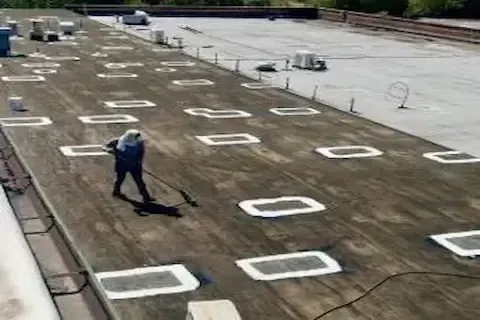
What Causes Commercial Roof Leaks on Plymouth Buildings
Commercial roof leaks on Plymouth buildings most commonly result from failed seams, deteriorated flashings, punctures, ponding water, clogged drains, and compromised HVAC penetrations. Flat roofs — the dominant style on commercial buildings throughout Plymouth, MN — are especially vulnerable because they rely on membrane integrity and proper drainage rather than slope to shed water. When any single component fails, water finds a path inside. Identifying the specific cause is the first step toward a lasting repair rather than a temporary fix.
What Makes Flat Roof Seams and Membranes Fail?
The membrane system — whether TPO, EPDM, or modified bitumen — is your roof's primary waterproof barrier. Over time, seams where membrane sheets are joined together pull apart due to thermal cycling. Plymouth's climate subjects commercial roofs to dramatic temperature swings, from well below zero in January to 90-degree summer heat. That repeated expansion and contraction fatigues the adhesive bonds and heat-weld seams that hold the system together. Once a seam opens even slightly, water infiltrates freely. Membrane blistering, cracking, and surface erosion are also common after years of UV exposure and Minnesota freeze-thaw cycles.
How Do Flashing Failures Cause Commercial Roof Leaks?
Flashings are the metal or membrane termination strips installed at every edge, curb, wall transition, and penetration. They act as a bridge between the flat membrane and vertical surfaces. When flashings lift, crack, or lose their sealant bond, water channels directly behind the membrane and into the building structure. On Plymouth commercial buildings, flashing failures around parapet walls and rooftop equipment curbs are among the most frequently diagnosed leak sources. These areas experience the most movement stress and are often the last to receive preventive maintenance attention.
Can Rooftop Punctures Really Cause Significant Leaks?
Yes — even small punctures create serious water intrusion problems. Rooftop foot traffic from HVAC technicians, satellite dish installers, or maintenance personnel can puncture membrane material with dropped tools, equipment feet, or simply walking on a vulnerable membrane without protective walk pads. Hail damage is also a puncture source on Plymouth commercial properties, particularly after severe spring and summer storms. Because flat roofs don't visually reveal damage the way sloped roofs do, punctures often go undetected until water shows up inside the building — sometimes weeks later and well away from the actual entry point.
Why Is Ponding Water a Leading Cause of Commercial Roof Leaks?
Ponding water — water that remains on the roof surface 48 hours or more after rainfall — is one of the most destructive conditions for commercial flat roofs. Standing water accelerates membrane degradation, adds excessive structural load, and creates freeze-thaw damage at the water's edges during Plymouth winters. Over time, the constant saturation softens adhesives, promotes algae and vegetation growth that roots into the membrane, and eventually forces water through even minor surface imperfections. Improper roof slope during original installation or a sagging deck structure are the typical causes of chronic ponding on Plymouth commercial buildings.
How Do Clogged or Failed Drains Lead to Leaks?
Flat roofs depend entirely on internal drains, scuppers, and gutters to move water off the surface quickly. When drains become blocked by debris — leaves, gravel, windblown material, or even bird nests — water backs up and pools. The longer water sits, the higher the risk of intrusion at any nearby seam or flashing. In Plymouth's fall season, leaf accumulation can overwhelm roof drains rapidly. Drain flashings themselves can also fail where the drain body meets the surrounding membrane, creating a direct infiltration point at what should be a controlled water exit. Routine drain clearing is one of the most cost-effective preventive measures available.
Do HVAC Units and Rooftop Penetrations Cause Leaks?
Rooftop HVAC units, exhaust fans, pipes, conduit runs, and skylights all require penetrations through the roof membrane. Each penetration is a potential leak point. The curb flashing and pipe boot seals surrounding these penetrations degrade with age, UV exposure, and physical vibration from operating equipment. On Plymouth commercial buildings with older mechanical systems, the penetration flashings often outlive their expected service life long before the main membrane does. Condensation from HVAC systems can also introduce moisture at the curb level that gradually undermines the surrounding membrane adhesion. If your building has multiple rooftop units, each one represents an independent leak risk that should be inspected regularly.
What Should Plymouth Building Owners Do Next?
If you are seeing ceiling stains, wet insulation, or active dripping inside your Plymouth commercial building, the leak source is rarely directly above where water appears inside. Water travels along structural members and insulation before dropping through. A qualified Commercial Roof Repair contractor uses infrared scanning and methodical surface inspection to trace water back to the actual entry point rather than guessing. Addressing only the interior damage without identifying the rooftop source guarantees the problem will return. For context on what a structured repair process looks like, review these commercial roof repair essentials before scheduling an assessment.
Leak causes are much the same in any climate, and good roofing services start with a full inspection of seams, flashing and drains.
