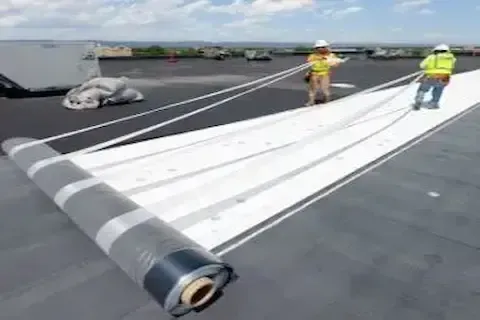
PVC Chemical Resistance for Plymouth Industrial Roofs
Not every flat roof faces the same threats. A warehouse in Plymouth storing dry goods has very different rooftop chemistry than a food processing facility, a commercial kitchen exhaust system, or a manufacturing plant venting solvents. When your operations involve grease-laden air, chemical vapors, or industrial exhaust residues, the membrane protecting your roof is not just a waterproofing layer — it is a chemical barrier. PVC roofing has earned a strong reputation in industrial settings precisely because its formulation resists the kinds of substances that degrade competing membranes over time.
Why Chemical Resistance Matters on Plymouth Industrial Roofs
Plymouth's industrial corridor along County Road 9 and the commercial zones near Highway 55 host a wide range of businesses — from light manufacturing and food service operations to auto service centers and distribution facilities. These businesses share one common challenge: rooftop equipment and exhaust systems deposit substances on the membrane surface throughout the year.
Grease from commercial kitchen ventilation is one of the most aggressive threats to roofing membranes. It doesn't just sit on the surface — it penetrates seams, softens adhesives, and accelerates UV degradation. Solvent vapors from manufacturing processes and petroleum-based exhaust residues create similar problems. Over time, these exposures break down the molecular structure of roofing membranes not designed to handle them, leading to cracking, delamination, and premature failure.
PVC — polyvinyl chloride — is inherently resistant to oils, fats, greases, and many common solvents. This is not a surface coating that can wear away. It is a property of the material itself, built into the membrane at the formulation stage.
How PVC Compares to TPO and EPDM Under Chemical Exposure
TPO membranes are widely used on commercial roofs and perform well in standard applications. However, TPO is a polyolefin-based material, and its resistance to oils and greases is significantly lower than PVC. On roofs above restaurant kitchens or food production areas, TPO seams exposed to grease exhaust can soften and lose adhesion faster than manufacturer warranties account for.
EPDM is a rubber-based membrane with excellent UV and ozone resistance, but it has a known vulnerability to petroleum-based products, oils, and certain solvents. For roofs where those substances are regularly present, EPDM can swell, soften, and deteriorate at an accelerated rate. Repair frequency increases, and the service life of the membrane falls well short of expectations.
PVC outperforms both in environments where:
- Commercial kitchen exhaust vents discharge directly onto or adjacent to the roof surface
- Industrial HVAC units carry solvent or chemical vapors from manufacturing processes
- Auto service or fleet maintenance facilities generate petroleum-laden air near roof penetrations
- Food processing operations produce animal fat or vegetable oil residues in exhaust streams
- Chemical storage facilities vent low-concentration fumes through rooftop systems
For a deeper overview of how PVC performs across standard commercial applications, review PVC membrane roofing essentials before evaluating whether it fits your specific facility.
The Role of Heat-Welded Seams in Chemical Environments
Material chemistry is only part of the equation. The seaming method matters just as much in chemically aggressive environments. PVC membranes are joined using hot-air welding, a process that fuses the overlapping edges of two sheets into a continuous bond at the molecular level. The result is a seam that is often stronger than the base membrane itself.
EPDM membranes rely on adhesive tape or contact cement at seams — bonding methods that are directly vulnerable to chemical degradation. When grease or solvent residues reach an EPDM seam, they attack the adhesive, not just the membrane surface. TPO seams are also heat-welded, but the base material's lower chemical resistance means the broader membrane is still at risk even if seams hold.
On Plymouth industrial facilities where exhaust discharge points are located near seams or at roof penetrations, PVC's welded seam system provides a meaningful structural advantage. Water and chemical infiltration pathways are simply fewer.
Installation Considerations for Industrial Applications
Chemical resistance doesn't mean zero maintenance. Even PVC membranes benefit from regular inspection, particularly on roofs with high exhaust activity. Grease accumulation can be physically removed without damaging PVC, but if it goes unaddressed for extended periods, it can still trap moisture and debris against the membrane.
Key installation details that matter in chemically active environments include:
- Exhaust stack flashing: Penetrations around kitchen exhaust stacks require custom-fabricated PVC boots or pre-formed pipe flashings that maintain the chemical resistance of the field membrane
- Membrane thickness: Industrial applications often warrant 60-mil or 80-mil PVC rather than the standard 45-mil used on light commercial roofs — the added thickness provides a longer service window against abrasion and chemical contact
- Grease containment pads: PVC-coated walk pads placed below exhaust discharge points help protect the field membrane from concentrated grease deposits
- Drain positioning: Chemical runoff should be routed toward drains quickly — flat or pooling areas near exhaust equipment increase dwell time and potential membrane contact
What Plymouth Businesses Should Ask Before Membrane Selection
If you are planning a new roof installation or a full replacement on a Plymouth commercial or industrial building, the decision between membrane types should include an honest assessment of what your rooftop environment actually contains. A standard commercial building with no rooftop kitchen or chemical exhaust can be well-served by TPO or EPDM. But if your operations involve any of the conditions described above, that baseline assumption can lead to premature failure and unplanned replacement costs.
Questions worth raising with your roofing contractor:
- What substances are discharged from our rooftop exhaust systems?
- Where are those discharge points relative to seams and penetrations?
- Has the existing membrane shown any signs of oil saturation or seam failure near exhaust equipment?
- What membrane thickness does our activity level warrant?
Plymouth businesses operating near the industrial parks off Xenium Lane or along the 494 corridor have a range of rooftop environments that don't always fit the assumptions built into standard commercial roofing quotes. Matching membrane selection to actual operating conditions is the step that separates a 10-year roof from one that starts requiring repairs in year four.
For facilities that have already confirmed chemical exposure is a concern, PVC Roofing offers a specification path built around these demands — one that leverages the material's inherent chemistry rather than working against it.
Long-Term Value of Getting the Specification Right
PVC carries a higher upfront material cost than TPO or EPDM in most installations. That cost difference narrows significantly — and often reverses — when you factor in reduced repair frequency, longer service life, and avoided early replacement on roofs with chemical exposure. For Plymouth industrial and commercial operators, the real question is not whether PVC costs more to install. It is whether the alternative costs more to own over time in the environment your building actually creates.
