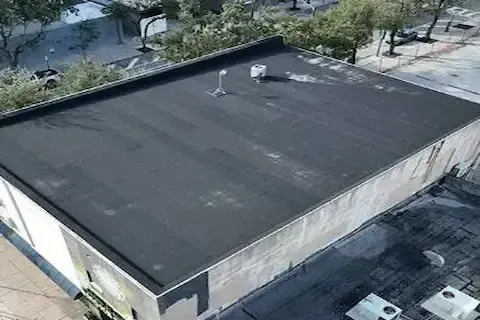
When Should a Plymouth Commercial Flat Roof Be Replaced
A Plymouth commercial flat roof should typically be replaced when it reaches 20–25 years of age, requires repairs more than twice per year, shows active moisture infiltration across multiple zones, or when repair costs exceed 30% of replacement value. Minnesota's freeze-thaw cycles accelerate membrane degradation faster than national averages, making age and moisture mapping results the two most reliable replacement triggers for Plymouth building owners and facility managers.
What Are the Age Thresholds for Commercial Flat Roof Replacement?
Most commercial flat roof systems installed in Plymouth carry a functional lifespan of 20 to 25 years for TPO and EPDM membranes, and 15 to 20 years for older built-up roofing (BUR) systems. Once a roof crosses these thresholds, the membrane becomes brittle, seams lose adhesion, and minor weather events cause disproportionate damage. If your system was installed before 2005 and has not been fully replaced since, age alone justifies a professional assessment. Plymouth's harsh winters compound aging by cycling membranes through repeated freeze-thaw stress, shortening the practical end of useful life compared to roofs in milder climates.
What Do Moisture Mapping Results Tell You?
Infrared moisture scans and electronic leak detection surveys provide the clearest objective evidence for replacement versus continued repair. When moisture mapping reveals wet insulation covering more than 25% of the roof deck area, repair becomes economically indefensible. Saturated insulation loses its R-value, adds dead load to the deck structure, and creates conditions for mold and deck deterioration. Plymouth commercial roofing contractors performing these surveys on facilities along Highway 55 and the Bass Lake Road corridor consistently find that roofs showing widespread moisture infiltration rarely benefit from targeted patching — the moisture has already migrated beyond visible damage zones.
How Often Should Repairs Happen Before Replacement Makes More Sense?
If your Plymouth commercial property requires emergency roof repairs or significant patching more than twice within a 12-month period, you have crossed the threshold where replacement delivers better financial outcomes than continued maintenance. Frequent repairs indicate systemic membrane failure rather than isolated damage. Each repair mobilization carries contractor call-out costs, interior disruption, and insurance claim implications. Tracking repair invoices over a three-year window is a practical discipline — when cumulative repair spending approaches 30% of a current replacement quote, capital planning for full replacement should begin immediately. For Commercial Roof Replacement guidance specific to Plymouth facilities, professional assessment is the appropriate starting point.
What Capital Planning Triggers Should Facility Managers Watch For?
Beyond age and repair frequency, several capital planning signals indicate replacement timing has arrived. These include warranty expiration on existing membrane systems, upcoming tenant lease renewals where roof condition affects lease negotiations, planned HVAC equipment replacements that require roof penetrations, and insurance carrier inspections flagging roof condition as a coverage risk. Plymouth facility managers overseeing multi-tenant industrial or office properties near the Interstate 494 and County Road 6 interchange should align roof replacement with lease cycle timelines to minimize disruption and maximize capital efficiency.
How Do Minnesota's Weather Conditions Factor Into Replacement Timing?
Plymouth experiences some of the most demanding roofing conditions in the upper Midwest. Average annual snowfall exceeds 54 inches, and temperature swings from minus 20°F in January to 90°F in July place extreme stress on membrane seams and flashing details. These conditions accelerate the degradation curve on all flat roof systems. A TPO membrane that might last 25 years in a southern climate may perform reliably for only 18 to 20 years in Plymouth. Scheduling replacement before visible failure — rather than after an emergency leak event — protects interior assets, avoids expedited contractor premiums, and preserves the ability to plan installation during favorable weather windows in spring or early fall. Understanding commercial re-roofing planning fundamentals helps facility teams sequence projects without weather-driven cost penalties.
Is Roof Restoration Ever a Valid Alternative to Full Replacement?
In specific circumstances, a fluid-applied silicone or acrylic restoration coating can extend a structurally sound roof's life by 10 to 15 years at roughly 50% of full replacement cost. Restoration is appropriate only when the existing membrane is mechanically intact, moisture infiltration is minimal and isolated, and the roof deck shows no structural compromise. Plymouth commercial facilities with roofs in the 15-to-18-year range showing limited localized damage are candidates for restoration evaluation. However, restoration is not a solution for roofs with widespread moisture, failed flashings at parapet walls, or structural deck deflection — conditions that require full replacement regardless of budget preference.
